
On Tuesday, September 16, the Sapporo Campus was certified as a Nature Coexistence Site under the Act on Promoting Activities to Enhance Regional Biodiversity (Regional Biodiversity Enhancement Act). Following this, on Tuesday, September 30, Kazuyoshi Nemoto, Specially Appointed Professor at the Institute for the Advancement of Sustainability; Shingo Kitaoka, Specially Appointed Associate Professor at the same organization; and Katsuhiko Hiroshige, Deputy Director of the Tokyo Office, attended the “First Natural Coexistence Site Certification Ceremony for FY 2025” held at the Sabo Kaikan in Chiyoda Ward, Tokyo. There, they were presented with the Certificate and Commemorative Plaque of Natural Coexistence Sites.
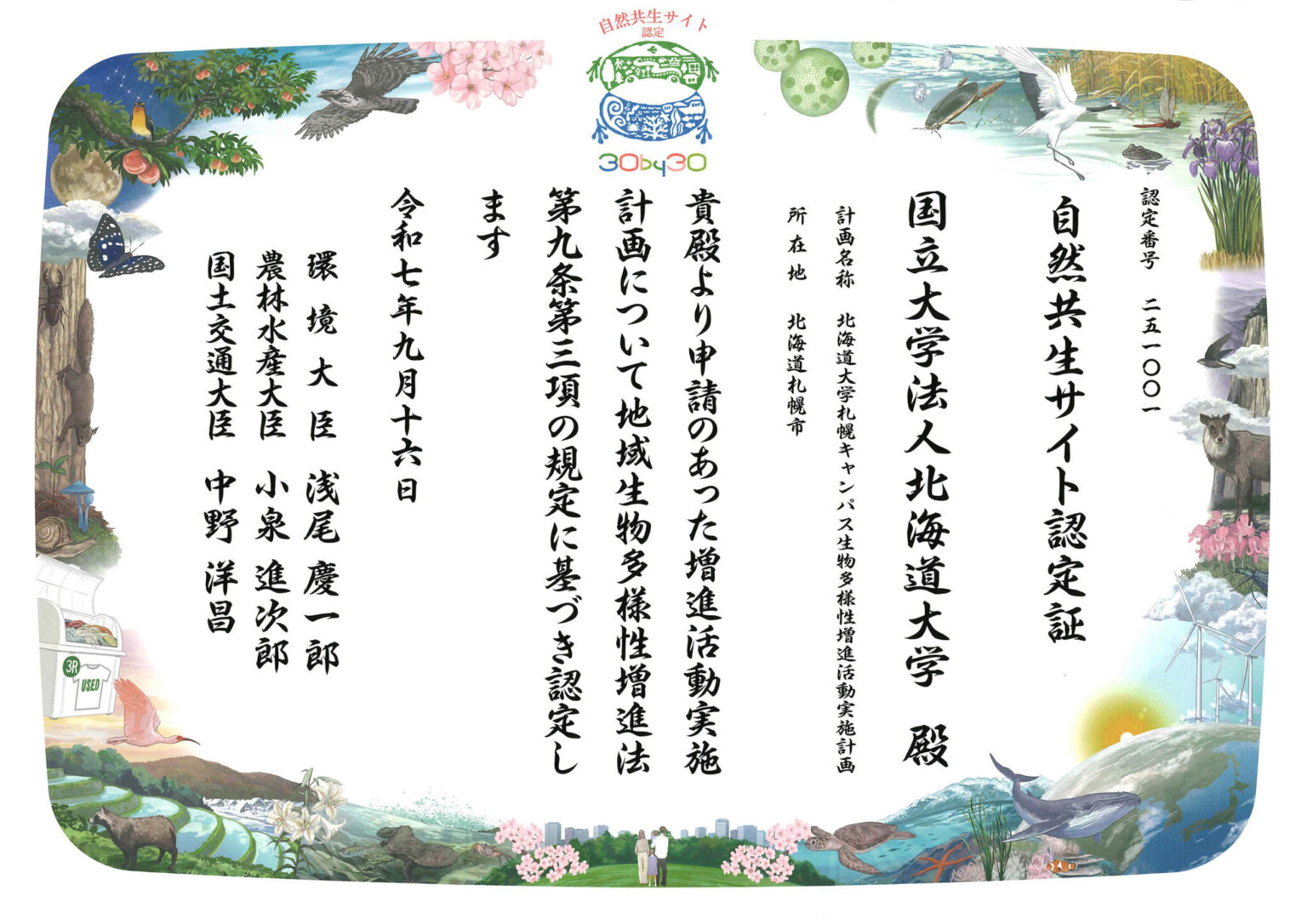
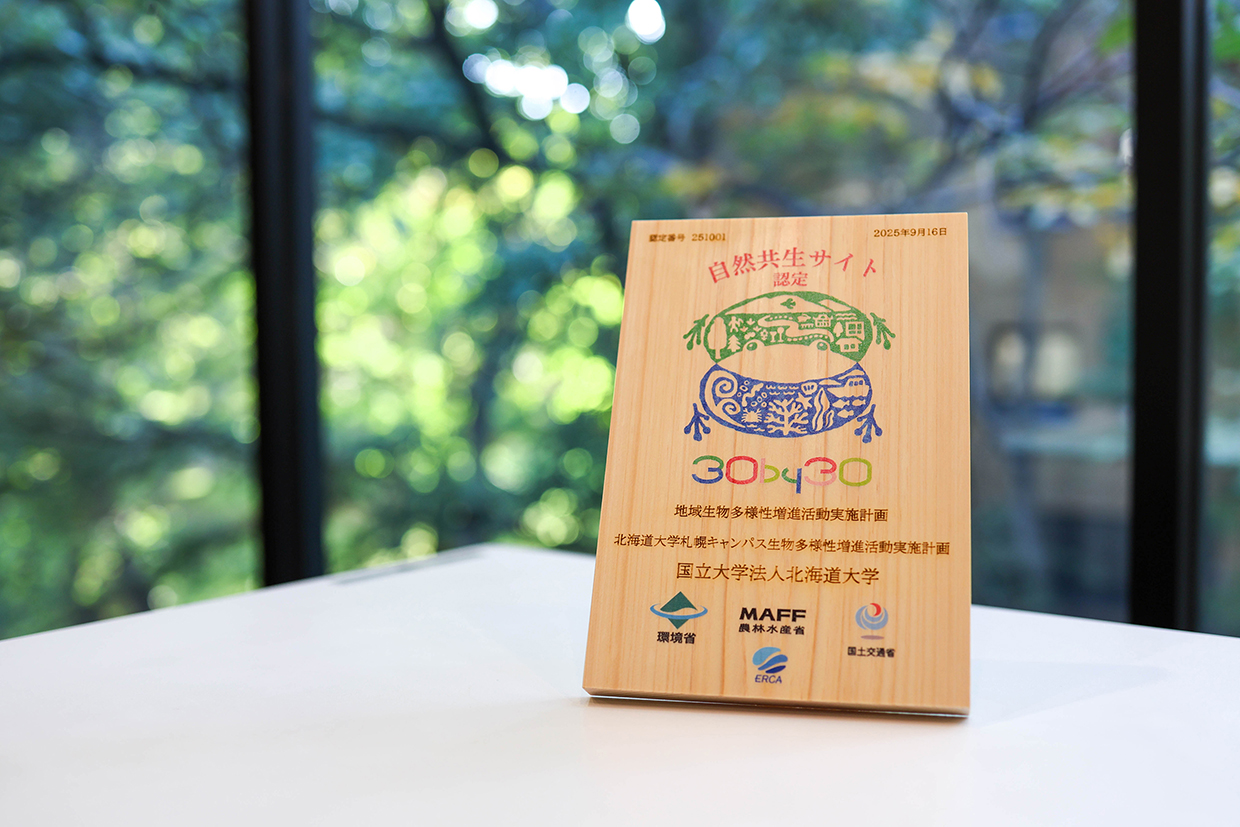
The Nature Coexistence Site certification system, launched in fiscal year 2023, recognizes areas where biodiversity conservation is achieved through private sector initiatives—such as corporate forests, satoyama landscapes (traditional rural landscapes shaped by the interaction between people and nature), and urban green spaces—as “Nature Coexistence Sites” by the Ministry of the Environment and other entities. This initiative is one of the efforts toward achieving a Nature Positive society.
In April 2025, the Regional Biodiversity Enhancement Act came into effect, incorporating the Natural Coexistence Site Certification system into law to further promote private-sector activities toward a Nature Positive society.
Under this law, “Enhancement Activity Implementation Plans” created and implemented by companies and NPOs, as well as “Collaborative Enhancement Activity Implementation Plans” compiled by municipalities in cooperation with diverse local stakeholders, are certified by the competent ministers (Minister of the Environment, Minister of Agriculture, Forestry and Fisheries, and Minister of Land, Infrastructure, Transport and Tourism). The implementation areas of these certified plans then become “Nature Coexistence Sites” under the law.
Hokkaido University previously had the Uryu Research Forest and Sapporo Campus certified as Nature Coexistence Sites, registered in the OECM International Database*. This time, following the legal establishment of the Nature Coexistence Site system, the Sapporo Campus’s Implementation Plan for Enhancement Activities was certified under the new legal framework, and its implementation area was designated as a Nature Coexistence Site.
*OECM: Abbreviation for Other Effective Area-based Conservation Measures. This refers to areas outside national parks and other protected areas that contribute to biodiversity conservation.
Go to the Institute for the Advancement of Sustainability website.